Bible Mysteries
Why Did Jesus Look Up Before Breaking the Bread?
Introduction: The Math of the Wilderness 🧮
The scene in Matthew 14 is one of the most relatable, yet stressful moments in Scripture. It is late, the location is a desolate wilderness, and the need is overwhelmingly massive. Scholars estimate that with women and children included, the crowd could have numbered over 15,000 people.
The disciples are frantic. They are doing the "math of the wilderness." They look at the size of the crowd, then they look at their meager resources—five small barley loaves and two dried fish—and they come to the only logical conclusion: It is mathematically impossible.
The disciples saw the lack. They saw the deficit. Their solution was practical but faithless: "Send them away." They wanted to disperse the problem because they couldn't fix it. But Jesus saw something else. He did not focus on the scarcity of the bread; He focused on the sufficiency of the Father.
The turning point of this miracle did not happen when the bread physically multiplied in the baskets; it happened the moment Jesus shifted His gaze. It happened when He refused to let the "not enough" on earth dictate the "more than enough" of Heaven.
https://youtube.com/shorts/cOdBdAcUoXQ
Part I: The Posture of Dependency (Looking Up) 👆
Free 7-Day Journey
Go Deeper Into Scripture
7 cinematic devotionals delivered to your inbox — one story, one verse, one life-changing truth per day.
No spam. Unsubscribe anytime.
Breaking Eye Contact with the Problem
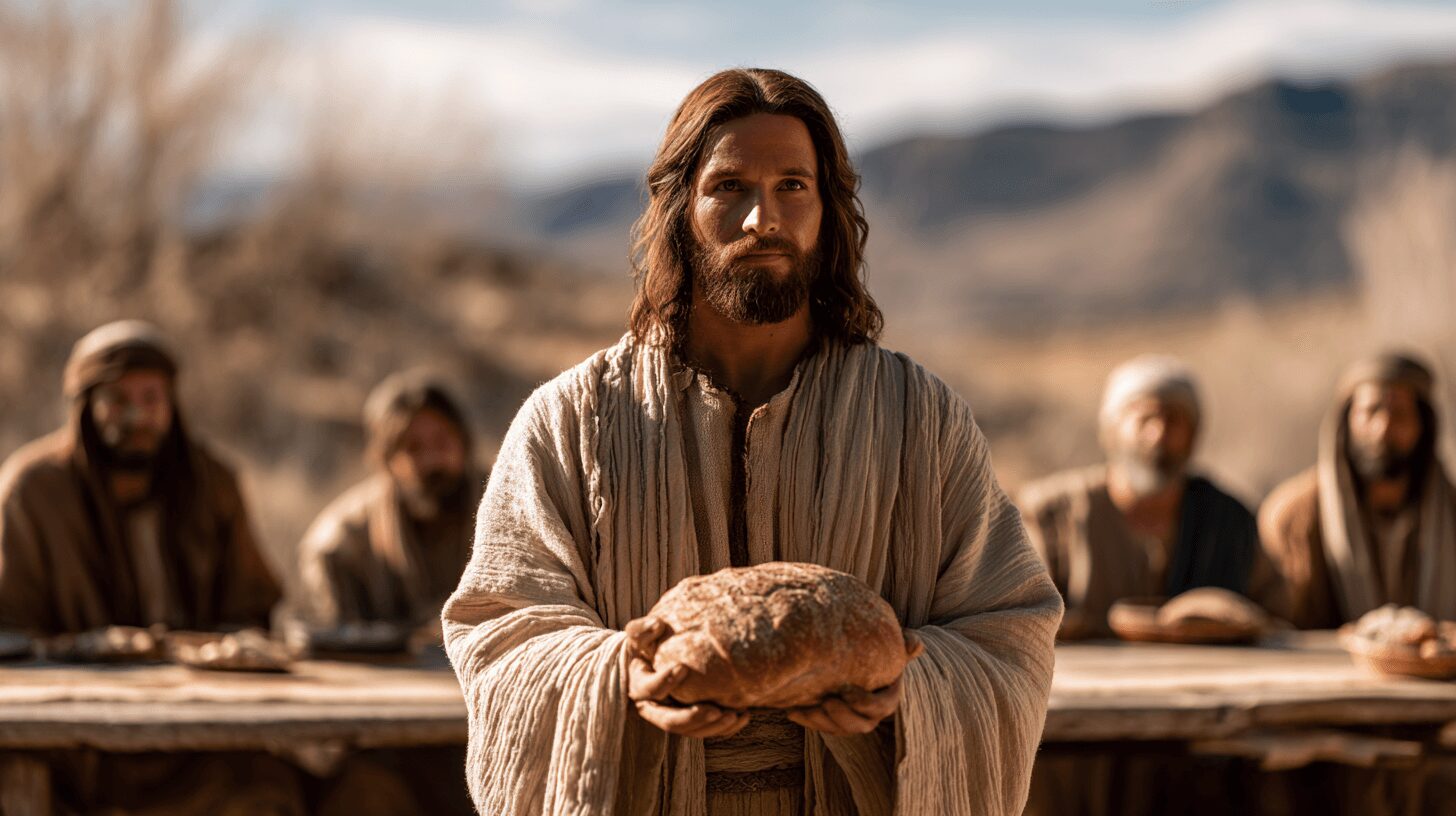
Before Jesus performed the miracle, He performed an act of profound submission and redirection. Scripture specifically notes His posture: "He took the five loaves and the two fish, and looking up to heaven..." (Matthew 14:19).
- The Key: Jesus physically looked away from the problem (the hungry, restless crowd) and the limitation (the small boy's lunch) to look at the Source.
- Deep Dive: In our own lives, we tend to stare at our problems until they consume our entire field of vision. We fixate on the bank account balance, the medical diagnosis, or the broken relationship. We analyze the problem from every angle, hoping to find a solution, but often only finding more anxiety.
- Application: The miracle begins when we break eye contact with our lack. We must stop calculating the odds and start consulting the Creator. If you are feeling overwhelmed by what you don't have today, you need to shift your focus. Just as we explore in Psalms for trusting God , spiritual stability returns the moment we stop looking at the waves and start looking at the One who rules them.
Part II: The Power of Thanksgiving (Giving Thanks) 🙏
Gratitude Before Multiplication
Jesus did something completely counterintuitive: He gave thanks before the miracle happened. He didn't wait for the baskets to be overflowing to say "Thank you." He held up the insufficient amount—the meager five loaves—and thanked God for it as if it were a feast.
- The Key: "He blessed and broke..."
- Deep Dive: In the Jewish tradition, this blessing (the Berakhot) acknowledges God as the King of the Universe who brings forth bread from the earth. By blessing the food, Jesus was declaring that God is the owner of everything. Thanksgiving is the catalyst for multiplication. When we complain about what we lack, we constrict our spirit and blind ourselves to opportunity. When we thank God for what we have, we invite His presence into the equation.
- Application: This is the secret to abundance. It is the same principle we practice in our Morning Psalms of praise —tuning our hearts to gratitude before the day's demands even begin. Do not despise the day of small beginnings. Hold up your "five loaves"—your small talent, your limited time, your remaining energy—and thank God for it.
Part III: The Blessing of Breaking (Breaking the Bread) 🥖
The Necessity of Brokenness
After looking up and giving thanks, Jesus broke the loaves. He didn't just multiply whole loaves; He multiplied the pieces.
- The Key: The bread had to be broken to be shared.
- Deep Dive: There is a profound spiritual principle here: limitation often leads to multiplication, but only through brokenness. We often fear being broken. We think that if we are broken—financially, emotionally, or physically—we are useless to God. But in the hands of the Master, brokenness is often the preparation for distribution. A whole seed does nothing; a broken seed produces a harvest. Jesus Himself was broken on the cross so that life could be distributed to the world.
- Application: If you feel shattered by life's circumstances, remember that you are not destroyed; you are being prepared. You are in the Master's hands. There are Psalms for healing that remind us that God is close to the brokenhearted, and it is often through our cracks that His light shines the brightest to feed a hungry world.
Conclusion: Twelve Baskets Left Over 🙌
The story ends with a detail we cannot ignore: "So they all ate and were filled, and they took up twelve baskets full of the fragments that remained" (Matthew 14:20).
God did not just meet the need; He exceeded it. There was a basket left over for every doubting disciple.
The miracle of the five thousand teaches us that the resources of earth are limited, but the resources of Heaven are infinite. Jesus looked up not to check if help was coming, but to remind us where help always comes from.
When you keep your life in your own hands, it will never be enough. It will always be "five loaves" in a hungry world. But when you lift it to the Father, bless it with gratitude, and allow it to be broken for others, even the little becomes abundance.
Reflection: What "five loaves" do you need to stop worrying about and start lifting up today?
📚 For Further Study
| Category | Study Topic | Recommended Link |
|---|---|---|
| Miracles | Feeding the 5000 | Ligonier: Jesus Feeds the Five Thousand |
| Theology | The Source of Supply | Spurgeon: The Miracle of the Loaves |
| Practice | Giving Thanks | GotQuestions: Why is giving thanks important? |
| Context | Jewish Blessings | The Berakhot: Blessing God for Food |
Did this article bless you? Share it!
Frequently Asked Questions
For Pastors & Church Leaders
Bring This Story to Life in Your Church
Cinematic sermon visuals, ready-to-use slides, and discussion guides — crafted for busy pastors who want depth without the hours.
Free 7-Day Journey
Unlock the Book of Revelation
7 days of guided study through end-times prophecy — no seminary required. Clarity on the seals, trumpets, and the return of Christ.
No spam. Unsubscribe anytime.