Church Technology
What Does the Bible Say About Artificial Intelligence? A Christian Perspective
TL;DR
The Bible provides a rich framework for engaging AI: the imago Dei establishes that AI is not a person and cannot replace human dignity; the Tower of Babel warns against technology in service of pride; Proverbs distinguishes information from wisdom; and the New Testament's commitments to truth, community, and the Holy Spirit's work remain central. Christians should engage AI with stewardship, accountability, and love for neighbor.
Free 7-Day Journey
Go Deeper Into Scripture
7 cinematic devotionals delivered to your inbox — one story, one verse, one life-changing truth per day.
No spam. Unsubscribe anytime.
What Does the Bible Say About Artificial Intelligence? A Christian Perspective
Artificial intelligence is not mentioned in the Bible. Neither is the internet, the printing press, or the steam engine. Yet the Bible has profound things to say about technology, human nature, wisdom, and the proper ordering of human creativity — and these teachings provide a rich framework for thinking about AI from a Christian perspective.
This article does not offer a simple verdict on AI. It offers something more valuable: a biblical lens through which Christians can evaluate AI thoughtfully, engage it wisely, and avoid the twin errors of uncritical adoption and reflexive rejection.
The Question Behind the Question
When Christians ask "what does the Bible say about AI?", they are usually asking a deeper question: Is AI a threat to human dignity, to faith, or to the Church? Or, from the other direction: Is AI a gift from God that we should embrace?
Both of these framings reveal an important truth: the question of AI is ultimately a question about what it means to be human. And that is precisely where the Bible has the most to say.
Human Beings as Image-Bearers
The most foundational biblical teaching relevant to AI is found in the opening chapter of Genesis:
"So God created mankind in his own image, in the image of God he created them; male and female he created them." — Genesis 1:27
The imago Dei — the image of God — is the theological cornerstone of Christian anthropology. Human beings are unique among all created things because they bear the image of their Creator. This image includes, among other things, the capacity for reason, creativity, moral judgment, relationship, and worship.
AI systems, however sophisticated, do not bear the image of God. They are not persons. They cannot pray, repent, love, or worship. They do not have souls. They cannot experience grace or be held morally accountable. This distinction is not a minor technical detail — it is the most important thing to understand about AI from a Christian perspective.
This does not mean AI is evil or that Christians should avoid it. It means that AI occupies a fundamentally different category from human beings, and that any use of AI that blurs this distinction — treating AI as if it were a person, or treating human beings as if they were machines — is theologically problematic.
The Tower of Babel: A Warning About Technology Without Humility
The story of the Tower of Babel (Genesis 11:1–9) is often read as a simple story about God confusing human languages. But it is also a profound reflection on the relationship between human technological capability and human pride.
The builders of Babel were not doing something inherently evil. They were building — exercising the creative capacity that God had given them. The problem was their motivation: "Come, let us build ourselves a city, with a tower that reaches to the heavens, so that we may make a name for ourselves" (Genesis 11:4). Technology in the service of human pride, self-sufficiency, and the displacement of God — this is what Babel warns against.
The warning is directly applicable to AI. The question is not whether AI is powerful — it clearly is. The question is whether we are using that power in humble service of human flourishing and God's purposes, or whether we are using it to "make a name for ourselves," to achieve a kind of technological transcendence that displaces our dependence on God.
Proverbs and the Wisdom Tradition
The book of Proverbs has much to say about wisdom, discernment, and the proper use of knowledge. Several principles are directly relevant to AI:
"The beginning of wisdom is this: Get wisdom, and whatever you get, get insight." (Proverbs 4:7) AI can provide information, but it cannot provide wisdom. Wisdom, in the biblical sense, is the capacity to apply knowledge rightly — in alignment with God's purposes, in service of genuine human flourishing, with appropriate humility about the limits of our understanding. This is a distinctly human capacity, developed through experience, community, and the fear of the Lord.
"Where there is no guidance, a people falls, but in an abundance of counselors there is safety." (Proverbs 11:14) AI can serve as a kind of counselor — providing information, analysis, and recommendations. But the biblical vision of counsel is relational and accountable. The "abundance of counselors" in Proverbs are people who know you, who are accountable to the same moral framework you are, and who can be held responsible for their advice. AI counselors have none of these qualities.
"A lying tongue hates those it hurts, and a flattering mouth works ruin." (Proverbs 26:28) AI systems are capable of generating false information with great confidence. The phenomenon of "hallucination" — where AI produces plausible-sounding but factually incorrect statements — is a genuine risk, particularly when AI is used for theological or pastoral purposes. Christians who use AI must be vigilant about verifying the accuracy of AI-generated content.
The New Testament: Truth, Community, and the Spirit
The New Testament deepens the biblical framework for thinking about AI in several important ways.
Truth. Jesus describes himself as "the way, the truth, and the life" (John 14:6), and Paul instructs the Philippians to think about "whatever is true" (Philippians 4:8). The Church is called to be "a pillar and buttress of the truth" (1 Timothy 3:15). In an age when AI can generate persuasive falsehoods at scale, the Church's commitment to truth is more important than ever.
Community. The New Testament vision of the Church is profoundly communal. The body of Christ is made up of many members, each with different gifts, all interdependent (1 Corinthians 12). The ministry of presence — visiting the sick, comforting the grieving, bearing one another's burdens — is irreducibly embodied and relational. AI can support community, but it cannot constitute it.
The Holy Spirit. The New Testament promises that the Holy Spirit will guide believers into all truth (John 16:13) and will intercede for them "with groanings too deep for words" (Romans 8:26). The Spirit's work of illumination — bringing Scripture alive for specific people in specific moments — is not a function that can be replicated by AI. This is not a limitation of current AI; it is a statement about the nature of spiritual reality.
Stewardship: A Framework for Christian AI Engagement
The biblical concept of stewardship provides the most practical framework for Christian engagement with AI. Stewardship is the responsible management of resources that belong to God — including time, money, gifts, and the natural world. The same principle applies to technology.
Good stewardship of AI means:
Using it for genuine human flourishing. AI should be used in ways that genuinely serve people — saving time, increasing access to resources, enabling better communication — not in ways that primarily serve efficiency metrics or corporate profits.
Maintaining human accountability. AI systems should always operate under human oversight. The decisions that matter most — pastoral care, theological teaching, community leadership — should remain in human hands.
Being honest about what AI is and is not. Christians should neither overstate AI's capabilities (treating it as if it were wise, trustworthy, or spiritually discerning) nor dismiss them (refusing to use genuinely helpful tools out of fear or misunderstanding).
Protecting the vulnerable. AI systems can be used to manipulate, deceive, and exploit. Christians have a particular responsibility to protect vulnerable people — children, the elderly, the grieving, the spiritually seeking — from AI-enabled harm.
Common Questions Christians Ask About AI
Can AI be used for prayer? AI can help you find prayers, suggest prayer topics, or generate written prayers that you then make your own. But prayer is, at its core, a relationship between a human person and the living God. AI cannot pray on your behalf.
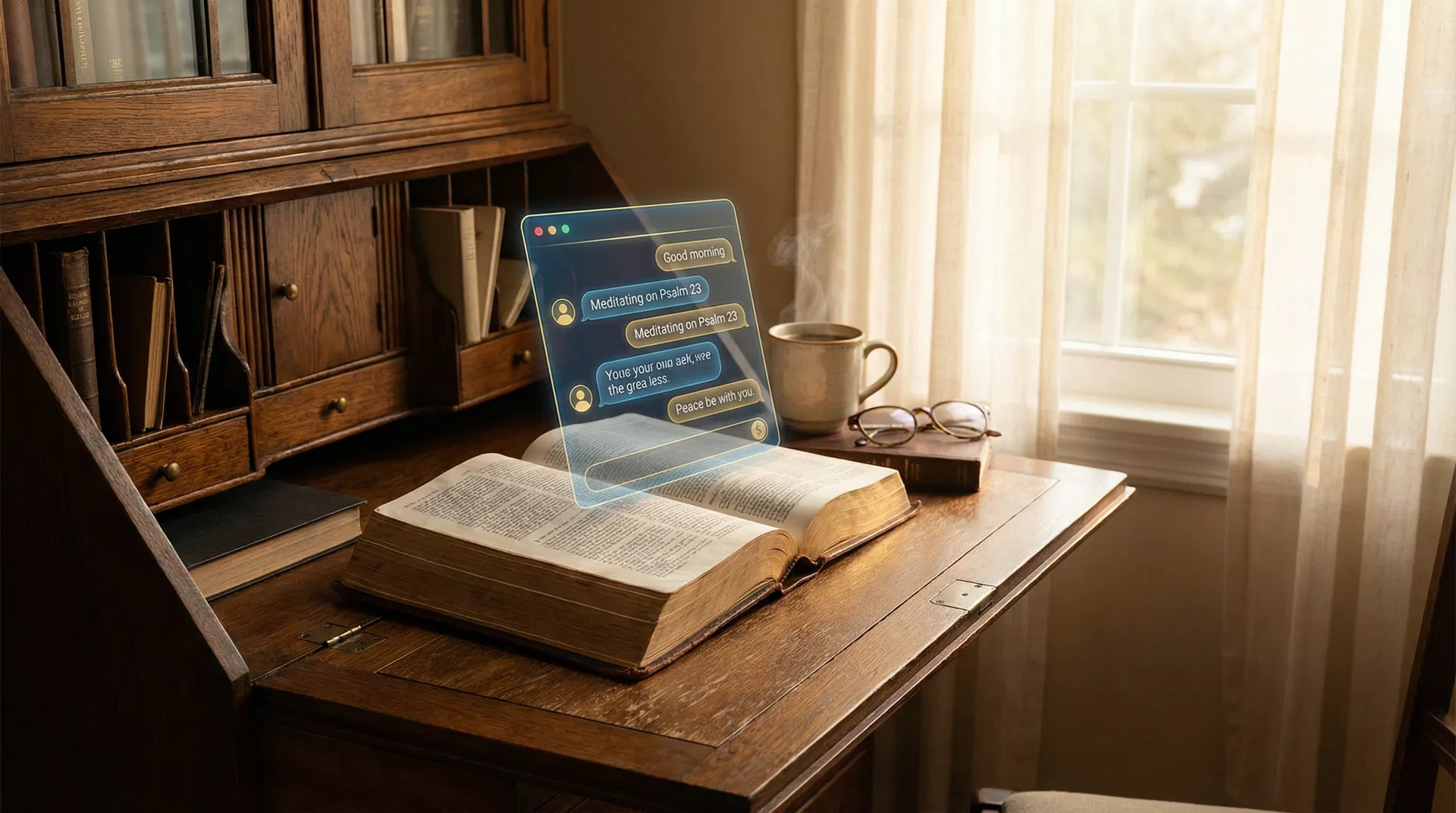
Is it wrong to use AI for Bible study? No. AI tools that help you understand Scripture — providing historical context, cross-references, commentary summaries — are no different in principle from a Bible dictionary or a commentary. The key is to use them as tools that support your own engagement with the text, not as substitutes for it.
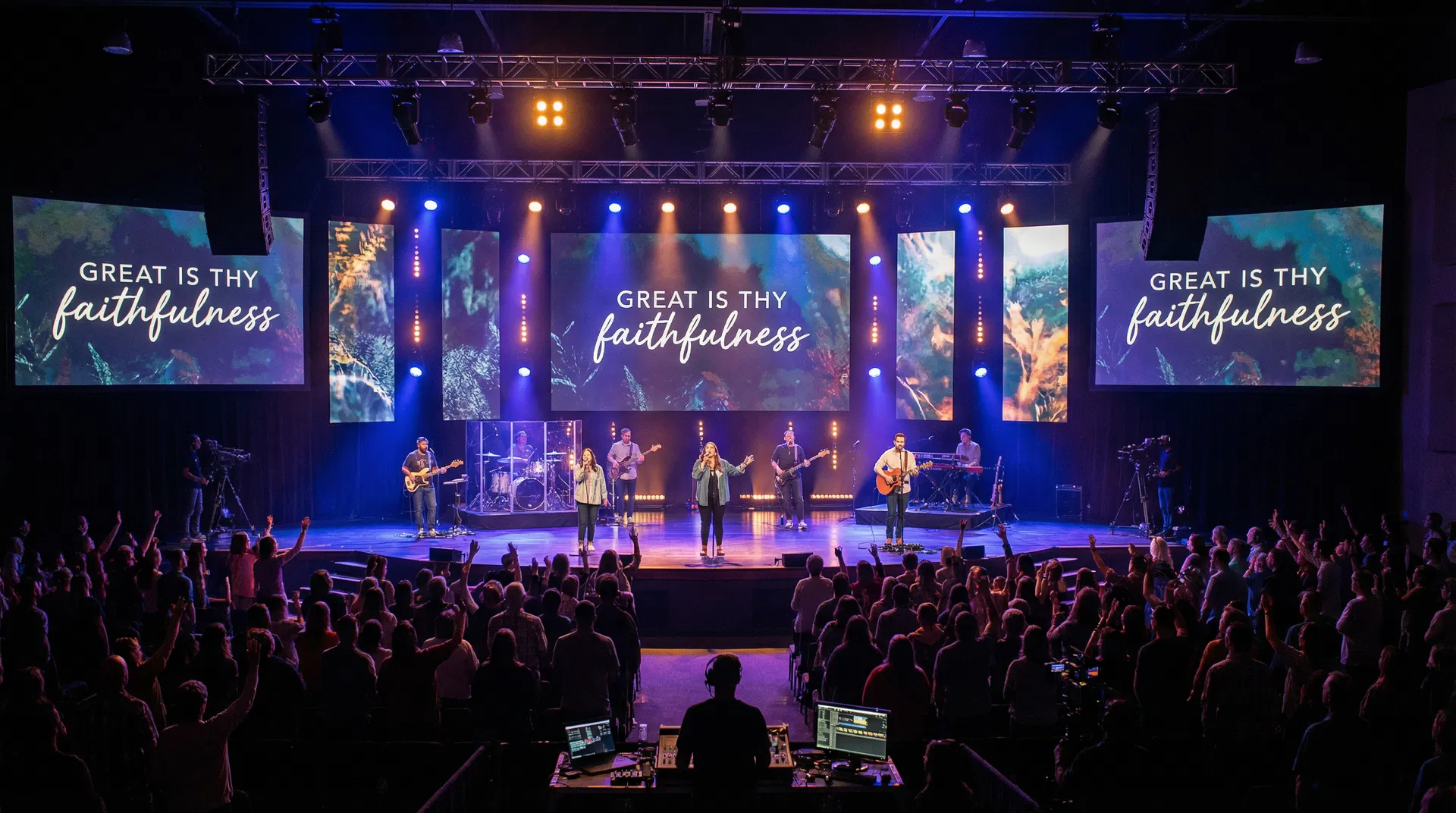
Should churches use AI-generated worship music? This is a genuinely contested question. The most important consideration is whether the congregation is genuinely worshipping — offering their hearts to God — through the music, regardless of how it was created. AI-generated music that facilitates genuine worship is not inherently problematic; AI-generated music that replaces genuine pastoral and artistic engagement with the worship of a specific congregation is more concerning.
Is AI a sign of the end times? Some Christians have speculated that AI is connected to biblical prophecies about the mark of the beast, the image of the beast (Revelation 13), or other end-times events. While these connections are worth thoughtful consideration, Christians should be cautious about confident prophetic interpretations of specific technologies. The Church has a long history of identifying contemporary technologies as end-times signs, and these identifications have consistently proven premature.
Conclusion: Engaging AI with Faith and Wisdom
The Bible does not give us a verdict on AI. It gives us something better: a vision of human dignity, a commitment to truth, a framework for wise stewardship, and a community of discernment in which to navigate complex questions together.
Christians who engage AI with this framework — taking human dignity seriously, refusing to confuse information with wisdom, maintaining accountability and transparency, and keeping the mission of the Church central — are well-equipped to use AI for genuine good.
The age of AI is not a crisis for the Church. It is an opportunity — to demonstrate what it looks like to engage powerful technology with humility, wisdom, and love for neighbor.
Explore Bible with Life's daily Bible reading plans, Scripture-centered devotionals, and free Christian wallpapers — resources designed to support your faith in an age of distraction.
Did this article bless you? Share it!
For Pastors & Church Leaders
Bring This Story to Life in Your Church
Cinematic sermon visuals, ready-to-use slides, and discussion guides — crafted for busy pastors who want depth without the hours.
Free 7-Day Journey
Walk With Jesus — Day by Day
7 cinematic devotionals on the life of Christ, delivered to your inbox. One story, one verse, one truth per day.
No spam. Unsubscribe anytime.