Bible Mysteries
Who Opens the Seven Seals in Revelation? Jesus’ End Times Role
The Book of Revelation stands as the Bible’s most mysterious and awe-inspiring prophetic book. It pulls back the curtain on the final chapters of human history, revealing cosmic battles, divine judgments, and the ultimate triumph of God. At the heart of this prophetic vision lies a central question: a scroll with seven seals is in the hand of God, and no one is found worthy to open it. The tension builds in heaven itself, and the destiny of the world hangs in the balance.
The identity of the one who is worthy to open this scroll is the key to understanding the entire End Times narrative. It reveals not just a moment of cosmic history, but the profound authority and central role of Jesus Christ in God's redemptive plan. This article will explain who opens the seven seals in Revelation , and why this act confirms Jesus's unparalleled authority in the universe.
--- ⭐ ---
📜 The Scene of the Heavenly Scroll
The vision in Revelation begins with John witnessing God seated on His throne, holding a scroll sealed with seven seals. This scroll represents God’s divine plan and the judgments to come. A mighty angel cries out, asking if anyone is worthy to open it, but no one in heaven or on earth is found worthy. The gravity of this moment is immense, for it signifies that without a worthy one, God’s ultimate purpose for creation cannot be fulfilled.
“And I saw in the right hand of him that sat on the throne a book written within and on the backside, sealed with seven seals. And I saw a strong angel proclaiming with a loud voice, Who is worthy to open the book, and to loose the seals thereof? And no man in heaven, nor in earth, neither under the earth, was able to open the book, neither to look thereon. And I wept much, because no man was found worthy to open and to read the book, neither to look thereon.” (Revelation 5:1-4, KJV)
The tears of John express the deep, existential dread of this moment. Without a worthy savior and redeemer, the world is left without hope. This sets up the grand reveal of the one who is uniquely qualified to step forward.
--- 💡 ---
🐑 The Lamb That Was Slain
Free 7-Day Journey
Go Deeper Into Scripture
7 cinematic devotionals delivered to your inbox — one story, one verse, one life-changing truth per day.
No spam. Unsubscribe anytime.
The tension is broken when one of the elders tells John not to weep, for the solution has arrived. He refers to the one who is worthy as “the Lion of the tribe of Juda,” a powerful symbol of a conquering king from the lineage of David.
🦁 The Lion of Judah and the Lamb
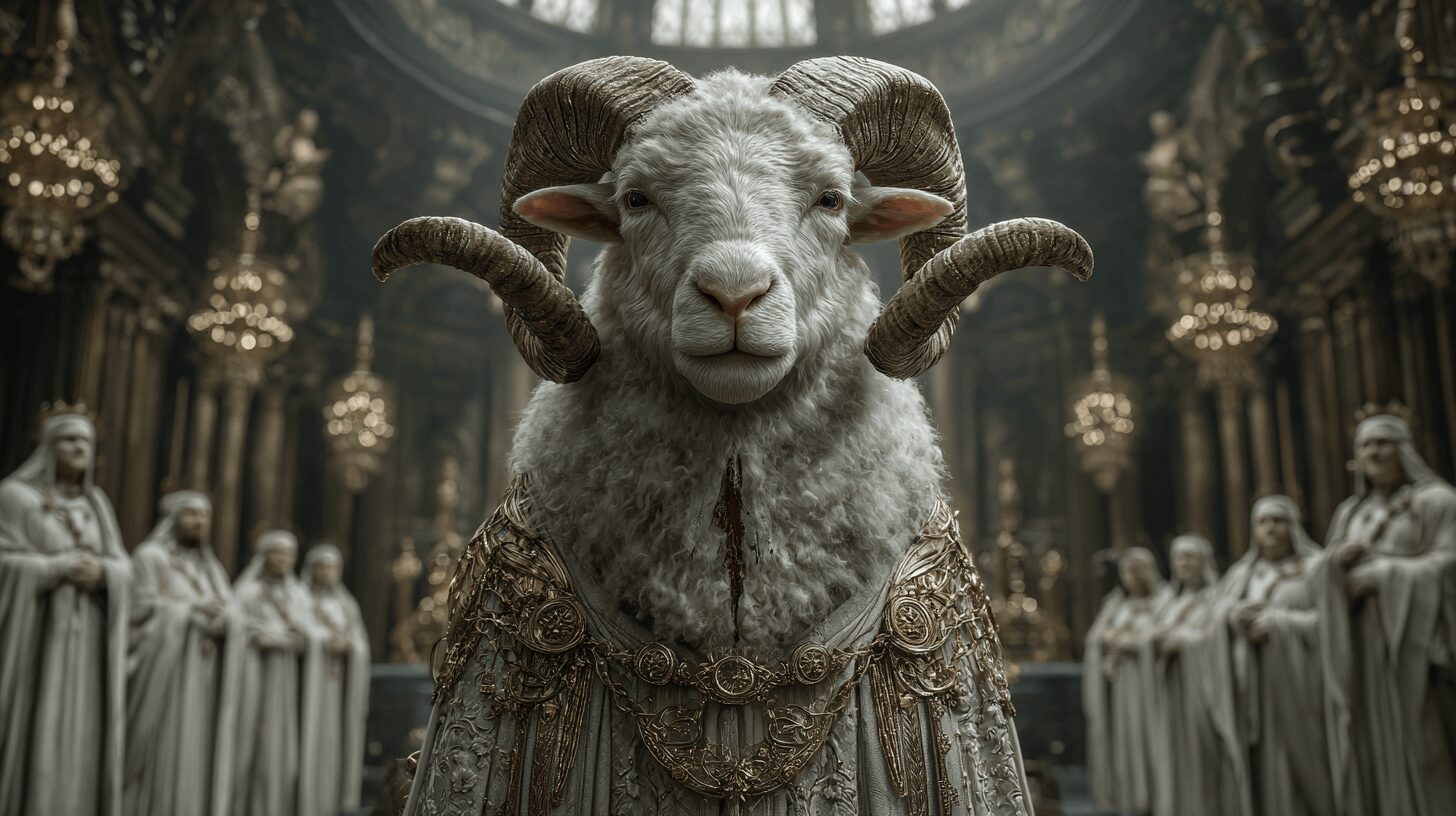
When John turns to see the Lion, however, he sees something entirely different and surprising. He sees a Lamb standing at the center of the throne, “as it had been slain.”
“And one of the elders saith unto me, Weep not: behold, the Lion of the tribe of Juda, the Root of David, hath prevailed to open the book, and to loose the seven seals thereof. And I beheld, and, lo, in the midst of the throne and of the four beasts, and in the midst of the elders, stood a Lamb as it had been slain, having seven horns and seven eyes, which are the seven Spirits of God sent forth into all the earth.” (Revelation 5:5-6, KJV)
This paradox—the conquering Lion revealed as the sacrificial Lamb—is the central truth of the Gospel. It is an image that perfectly captures the dual nature of Jesus Christ: He is the promised King of Israel, a powerful and fearsome Lion, yet His victory was achieved not through worldly might, but through His sacrificial death. He conquered sin and death by allowing Himself to be slain.
👑 Worthy to Open the Seals
The question of who opens the seven seals is therefore answered: it is Jesus, the Lamb who was slain. His worthiness comes from His perfect life, His atoning death, and His glorious resurrection. He alone paid the ultimate price to redeem humanity and creation.
“And they sung a new song, saying, Thou art worthy to take the book, and to open the seals thereof: for thou wast slain, and hast redeemed us to God by thy blood out of every kindred, and tongue, and people, and nation.” (Revelation 5:9, KJV)
This act of redemption, purchased with His blood, gives Him the absolute right and authority to open the scroll and execute God’s final plan. He is not a passive bystander; He is the sovereign orchestrator of every moment, from the beginning of creation to the culmination of all things. His role as the Lamb of God confirms His unparalleled authority. This is the cornerstone of the Christian faith and the reason why our hope for redemption is secure in Him. Read more about how Christ’s victory over death and hell gives us this security in our article, Did You Know That Jesus Christ Has Been to Hell?.
--- ⚖️ ---
🧭 The Meaning of the Seals
As Jesus opens the seals , the prophetic events of the End Times are set into motion. Each seal reveals a new element of God’s unfolding plan:
- First Four Seals: The famous Four Horsemen of the Apocalypse are unleashed, representing conquest, war, famine, and death. These are not random events, but judgments under the direct control of the Lamb.
- Fifth Seal: The souls of the martyrs cry out from under the altar, asking for justice. This shows that God remembers His persecuted saints and will avenge their blood in His perfect timing.
- Sixth Seal: Cosmic upheaval occurs—a great earthquake, the sun turning black, and the moon to blood. This is a terrifying sign of God’s wrath and a harbinger of the final Day of Judgment.
- Seventh Seal: This final seal is broken, leading to a silence in heaven before the seven trumpets are sounded, a new series of divine judgments.
The key to understanding these events is that they are all directly initiated by Jesus. His role in the End Times is not just as a returning King, but as the active agent who orchestrates the fulfillment of prophecy. This offers immense comfort to believers, knowing that even in chaos, their Savior is in complete control. Our article on The Final Battle of Armageddon further explores the fulfillment of these prophecies.
--- 👑 ---
🙌 Jesus’s Unparalleled Authority
The vision of the scroll and the Lamb is a powerful confirmation of Jesus's unique authority in the universe. He is the only one worthy to unveil God's plan because He is the only one who has conquered sin and death. This scene from Revelation teaches us that:
- Jesus is Sovereign over History: Every event, from the beginning to the end, is under His control.
- His Victory is Ultimate: The power of the Lamb who was slain triumphs over all worldly and spiritual evil.
- Our Hope is Secure: Because our Savior is the one who holds the scroll, believers can face the future with confidence, knowing that He is orchestrating all things for His glory and for the good of those who love Him.
This prophetic vision is not meant to incite fear, but to provide assurance. When we read Revelation, our focus should not be on the terrifying judgments, but on the Lamb who is worthy. It is a reminder that the same Savior who died on the cross is the one who will one day return to fully redeem His creation, as we discuss in The Return of Christ.
What do you find most comforting about Jesus’s role in orchestrating the events of the End Times? Share your thoughts in the comments below! 👇
For Further Study
Did this article bless you? Share it!
Frequently Asked Questions
For Pastors & Church Leaders
Bring This Story to Life in Your Church
Cinematic sermon visuals, ready-to-use slides, and discussion guides — crafted for busy pastors who want depth without the hours.
Free 7-Day Journey
Unlock the Book of Revelation
7 days of guided study through end-times prophecy — no seminary required. Clarity on the seals, trumpets, and the return of Christ.
No spam. Unsubscribe anytime.