Bible Mysteries
Why Did God Make a Dead Staff Blossom Overnight for Israel?
🌸 When God Uses a Stick to End a Mutiny ✨
Have you ever had your authority questioned? Have you ever had someone look at you and say, "Who put you in charge? Why are you so special?"
In Numbers 17 , Moses and Aaron were facing a national meltdown. The Israelites weren't just complaining about the food anymore; they were attacking the very structure of God's government.
A man named Korah had led a rebellion, arguing a very democratic point: "Ye take too much upon you, seeing all the congregation are holy, every one of them" (Numbers 16:3). His argument sounded good. Why just Aaron? Why just his family? Aren't we all God's people?
The consequences were catastrophic. The earth had opened to swallow the ringleaders. Fire had consumed 250 rebellious leaders. A plague had swept through the camp. The smell of death was everywhere.
But the people still grumbled. Fear hadn't silenced them. Judgment hadn't silenced them.
So God said, "Enough."
He didn't send another earthquake. He didn't send more fire. He asked for twelve sticks.
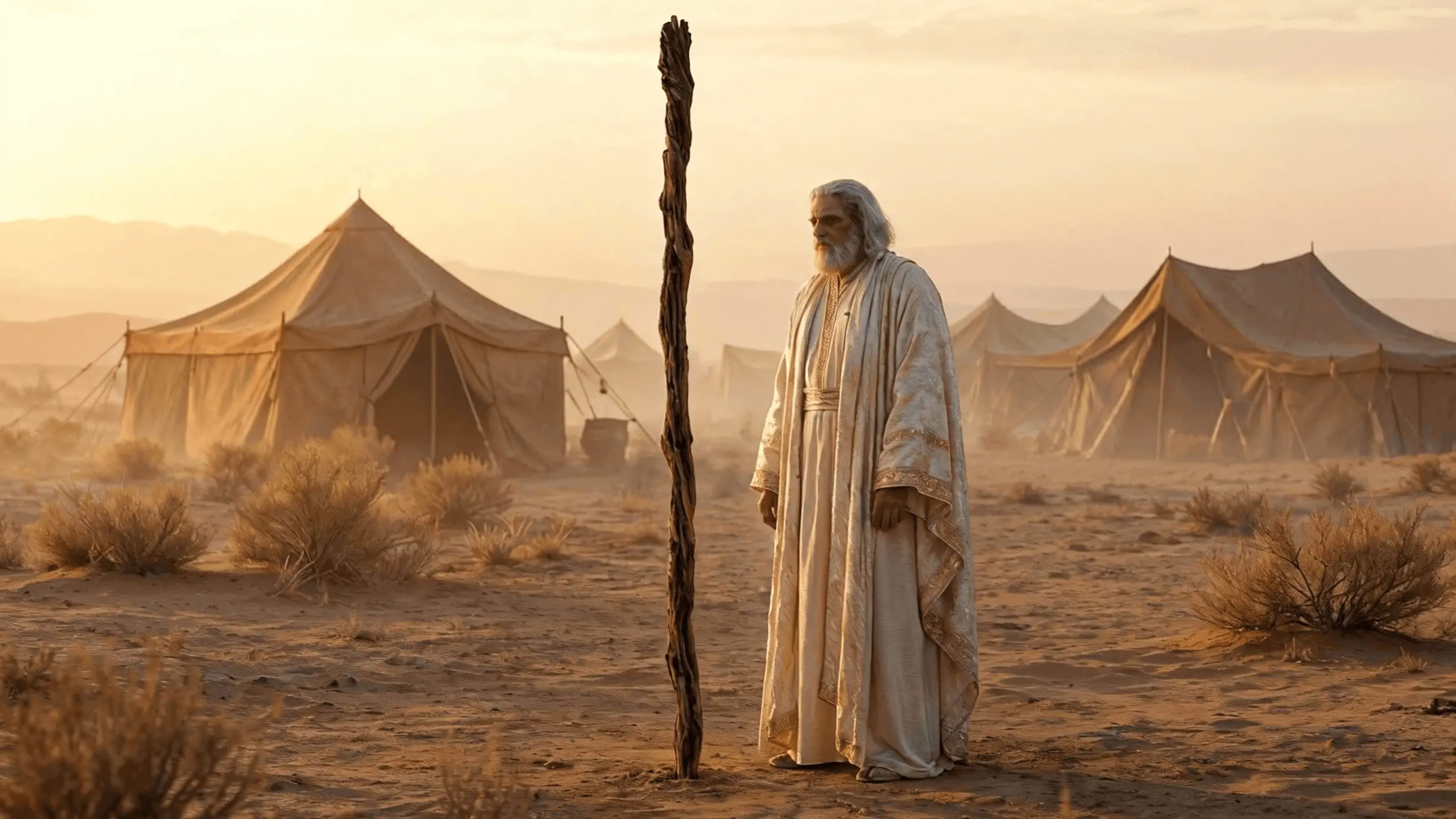
He commanded the leader of each tribe to bring a wooden staff—a dead, dry, severed piece of timber—and lay it in the Tabernacle. The next morning, the argument was settled forever. Not by death, but by Life.
Why did a dead staff bloom?
It was the ultimate signature of God. It proved that true spiritual authority isn't seized by ambition, nor elected by a majority vote; it is granted by the power of Resurrection.
Part I: The Test of the Timber 🪵
The Silent Night in the Holy of Holies 🕯️
God commanded Moses to write the name of each tribal leader on their staff. Aaron’s name was written on the staff of Levi. These rods were placed "before the testimony" (in front of the Ark of the Covenant).
Think about the environment. The Holy of Holies was pitch black, silent, and spiritually charged. It was the place where the Shekinah Glory dwelt between the cherubim.
For hours, twelve dead sticks lay in the presence of the Living God.
This was a test of origins.
- A man-made religion is like a dead stick: you can carve it, polish it, and decorate it, but it cannot produce life.
- A God-ordained ministry participates in the life of the Creator.
Nature says dead wood rots. God says dead wood listens.
Free 7-Day Journey
Go Deeper Into Scripture
7 cinematic devotionals delivered to your inbox — one story, one verse, one life-changing truth per day.
No spam. Unsubscribe anytime.
The Triple Miracle: Defying Time 🌿
When Moses entered the tent the next morning, eleven staffs were still just wood. They were as dry and lifeless as they were the night before.
But the twelfth—Aaron’s rod—had undergone a biological impossibility.
"Behold, the rod of Aaron for the house of Levi was budded, and brought forth buds, and bloomed blossoms, and yielded almonds." —Numbers 17:8 (KJV)
Notice the progression. In nature, an almond tree goes through a cycle over many months:
- Buds (Potential life)
- Blossoms (Beauty and opening)
- Fruit (Maturity and reproduction)
God did not just make it bloom. He made it exist in three seasons at once. The staff had the promise of the bud, the beauty of the flower, and the nourishment of the ripe nut simultaneously.
This was God showing that He is the Master of Time. He compressed the entire lifecycle of a tree into a single night to show that His chosen priesthood possessed a life that was supernatural, complete, and immediate.
Part II: Why Almonds? The Theology of the "Watcher" 👁️
The Tree That Wakes Up First ☀️
Why didn't God grow figs, olives, or grapes? Why almonds?
In Hebrew, the word for almond is shaqed. It comes from the root word "to watch" or "to wake" (shoqed).
In the Middle East, the almond tree is known as the "waker" or the "watcher." It is the very first tree to blossom in late winter (often as early as January), waking up while the rest of the world is still dead and sleeping.
By choosing almonds, God was sending a specific message to the rebels:
- I am Watching: God was not asleep to their rebellion. As He told Jeremiah: "I will hasten (shoqed - watch over) my word to perform it" (Jeremiah 1:11-12).
- I am the Firstfruits: God was establishing a priesthood that would be the "first" to wake from the dead.
The Token Against Rebels 🛡️
God commanded that the rod be kept inside (or before) the Ark of the Covenant as a "token against the rebels" (Numbers 17:10).
Why? Because human religion is always trying to invent its own way to God. We are always trying to carve our own sticks. The blooming rod was a permanent reminder: "You cannot produce spiritual life on your own. Only I can give it."
For more on the dangers of approaching God on our own terms, read Why Did Uzzah Die When He Touched the Ark?.
https://youtube.com/shorts/xq0O-4QUZuA
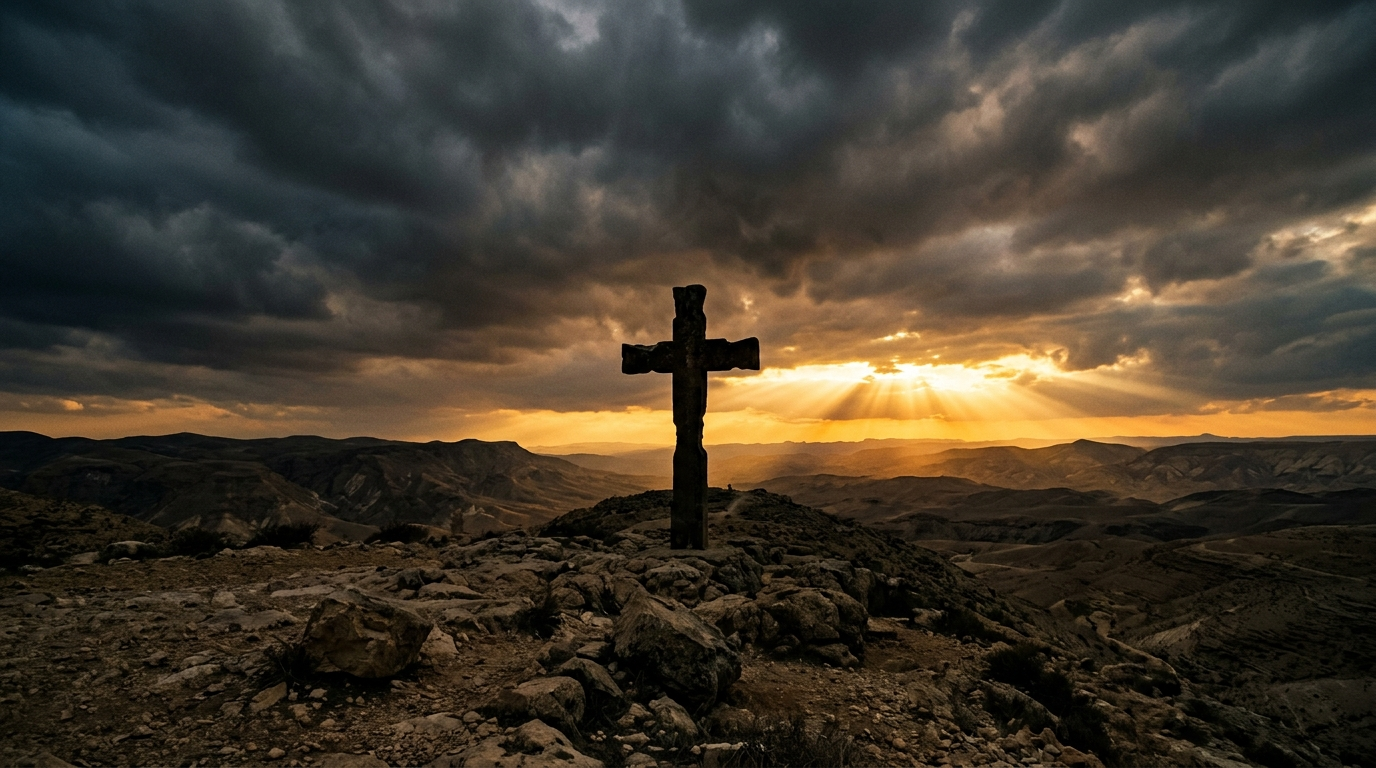
Part III: The Shadow of the Resurrection ✝️
The Root Out of Dry Ground 🌱
Aaron’s rod is one of the clearest pictures of Jesus Christ in the Old Testament.
Think about the parallels:
- The Dry Wood: Isaiah describes the Messiah as a "root out of a dry ground" (Isaiah 53:2). Jesus had no earthly beauty or royal army. He looked like a "dead stick" to the Roman world—a carpenter from Nazareth.
- Cut Off: Just as the staff was severed from the tree, Jesus was "cut off out of the land of the living" (Isaiah 53:8). He died.
- The Tomb: The staff was laid in the dark, silent Holy of Holies. Jesus was laid in the dark, silent tomb.
- The Life: On the third day, Jesus didn't just come back; He brought forth Fruit.
The Better Priesthood 👑
The book of Hebrews makes the ultimate connection. The Levitical priests (Aaron’s line) eventually died. Their staffs rotted.
But Jesus holds the priesthood not by a law or a lineage, but "after the power of an endless life" (Hebrews 7:16).
Aaron’s rod bloomed to prove he was the temporary high priest. Jesus rose from the dead to prove He is the Eternal High Priest. His resurrection is the "almond blossom" of history—the firstfruits of those who sleep (1 Corinthians 15:20).
For deeper insight into Christ’s divine nature, read 5 Bold Biblical Claims That Prove Jesus Is Truly God.
Part IV: 3 Common Misconceptions About Aaron's Rod 💡
Misconception 1: It was a magic wand.
- Correction: The power was not in the stick. The staff was just a piece of wood. The power was in the Presence of God. When we treat objects as sources of power (relics, crystals, icons), we commit idolatry. The staff was a sign , not a source.
Misconception 2: Aaron was chosen because he was holy.
- Correction: Aaron was a flawed man. This is the same Aaron who built the Golden Calf (Exodus 32)! God didn't choose Aaron because of his moral perfection; He chose him by Grace. The budding staff was a defense of God's sovereign choice , not Aaron's personal merit.
Misconception 3: The staff stayed blooming forever.
- Correction: While the staff was preserved for centuries inside the Ark, it eventually vanished. By the time of the destruction of Solomon's Temple (586 BC), the Ark and its contents were lost. This signifies that the Levitical priesthood was temporary. The only thing that lasts forever is the priesthood of Jesus.
Conclusion: Life Out of Your Dead Situations 🌟
Why did the staff bloom? To prove that God brings life where man sees only death.
Maybe you feel like a "dry rod" today.
- You feel cut off from your source.
- You feel dried up, brittle, and useless.
- You think your season of fruitfulness is over.
The world says, "Throw the stick in the fire." God says, "Lay the stick before My Presence."
Aaron’s rod tells you that one night in God’s presence can change everything. You don't need to try harder to squeeze out fruit. You just need to abide in the Holy of Holies.
God specializes in taking dead things—dead dreams, dead wombs (Sarah), dead marriages, dead Saviors—and making them bloom.
Reflection: What "dead stick" in your life do you need to stop striving over and simply lay before the Ark of God today?
Did this article bless you? Share it!
Frequently Asked Questions
For Pastors & Church Leaders
Bring This Story to Life in Your Church
Cinematic sermon visuals, ready-to-use slides, and discussion guides — crafted for busy pastors who want depth without the hours.
Free 7-Day Journey
Unlock the Book of Revelation
7 days of guided study through end-times prophecy — no seminary required. Clarity on the seals, trumpets, and the return of Christ.
No spam. Unsubscribe anytime.